Vanilla Policy Gradient
Topics: Reinforcement Learning
Overview
Vanilla Policy Gradient (VPG) is a model-free, policy optimization, algorithm that trains a stochastic policy in an on-policy way. It can be used in environments with discrete or continuous action spaces.
Its underlying principle is to push up the probabilities of actions that lead to a higher return and push down the probabilities of actions that lead to a lower return, until the optimal policy is reached.
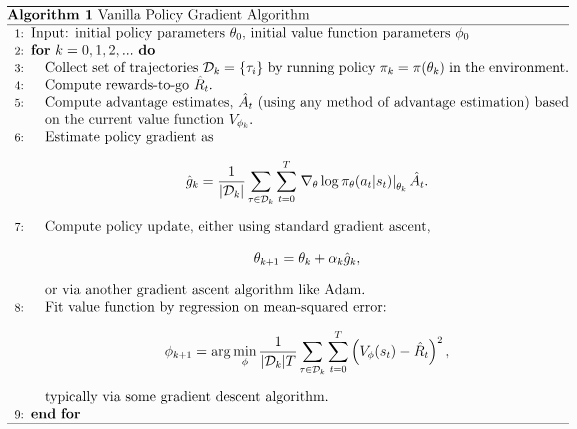
VPG is the basic policy optimization algorithm which updates the parameters of the actor network using gradient ascent. It also estimates the on-policy value function , which is used in approximating the advantage, which is in turn used in estimating the policy gradient.
Pseudocode
Exploration vs. Exploitation
Since VPG is on-policy, it samples actions from its current policy. Therefore, during the course of training, the policy becomes less random, which reduces exploration and could lead the policy to get stuck in a local optimum.
References
Backlinks
Notes that reference this page.
Connections
Direct relationships to this note.