Reflex: Reinforcement Learning with Reflection Symmetry Exploitation in State-Based Continuous Control
Contributions
- presents the theory behind symmetries in RL, group invariant MDPs and show that Bellman operator, value function and policy are all invariant under symmetry
- presents the 2 types of symmetries, axial and bilateral
- suggest a framework to exploit symmetry in the MDP for on-policy (PPO) and off-policy (SAC)
Group-Invariant MDPs
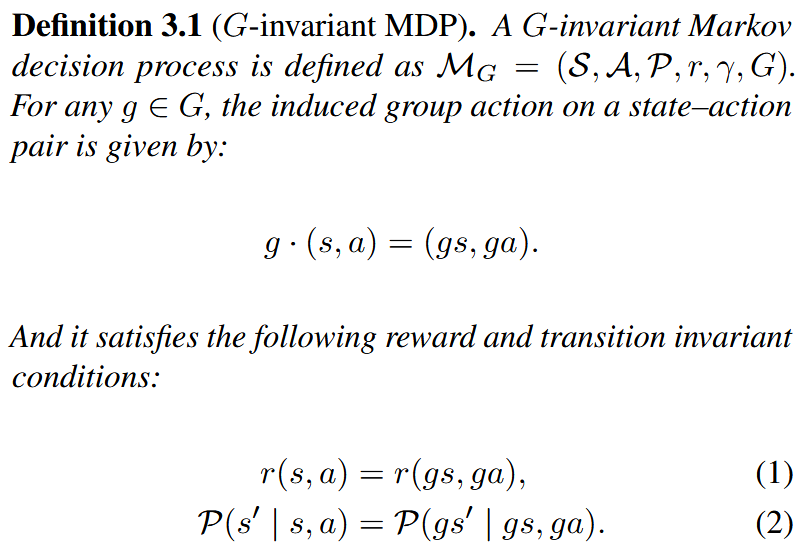
In short, the state-action pair and the transformed/equivalent state-action pair result in the same reward and in the transformed next state.
Under group-invariant MDPs, we have:
-
equivariance of the Bellman operator
-
invariance of optimal value functions
- equivariance of optimal policies
- equivariance of optimal policies
Reflection Symmetries
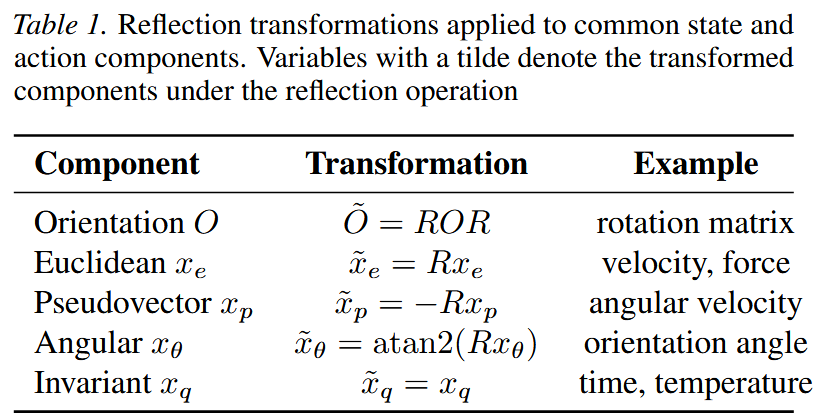
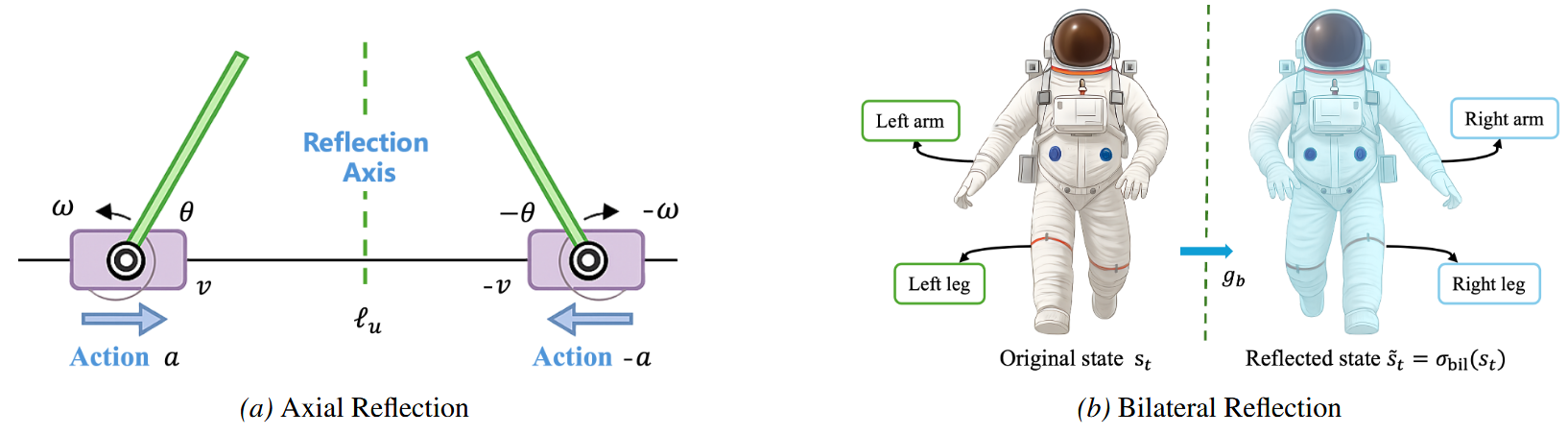
Axial Reflection
Transforms the elements of a state-action vector element-wise into an equivalent state-action vector based on the table below.
Bilateral Reflection
Case where the axis of reflection coincides with the agent's intrinsic symmetry axis. For example, the right-left sides of a humanoid. Mathematically it can be formulated as
where denotes the axial reflection based on the element type, and swaps the right and left components
Reflex PPO
For PPO, they introduce a reflection symmetry regularization that explicitly enforces equivariance in the learned policy:
Intuitively, this regularization promotes information sharing between symmetric components, allowing the policy to leverage mirrored experiences without additional environment interaction.
They additionally regularize the critic by enforcing value consistency:
The overall training objective is then the combination of the original PPO loss and the symmetry regularizations above:
where controls the strength of the symmetry regularization compared to the original PPO loss. This parameter decays linearly over time:
Reflex SAC
For SAC, the idea is to incorporate symmetry in the critic only.
First a symmetric target is computed, which enforces consistency of value estimates across mirrored state-action pairs:
- sample a mini-batch for training
- calculate its critic target value
- apply the symmetry transformation to obtain the mirrored next state
- calculate the reflected target
- calculate the final target as the average of the original and reflected targets
Then a symmetry-regularized critic loss is defined:
Connections
Direct relationships to this note.