Gang of Four
Topics: Feedback Systems
Overview
The Gang of Four is a set of four fundamental closed-loop transfer functions that characterize the input-output behavior and robustness of a standard one-degree-of-freedom feedback control system. They describe how different inputs (reference, disturbance, and sensor noise) propagate to the system output and control effort.
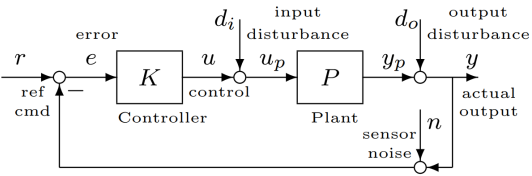
Considering the above negative feedback loop with plant P and controller K, the Gang of Four consists of:
-
Sensitivity Function (S):
- transfer function between the error term and the reference:
- Formula:
- Role: measures how much the system's output changes when its internal parameters or external inputs shift
- Insight: a high loop gain is desired to move the sensitivity to 0
-
Complimentary Sensitivity (T):
- transfer function between the output and the reference:
- Formula:
- Role: determines the reference tracking performance of the system, as well as the robustness to model uncertainty
- Insight: a high look gain is desired to move the complementary sensitivity to 1
-
P-Sensitivity (PS):
- transfer function between the output and the plant input disturbance:
- Formula:
- Role: specifies the impact of input disturbance on the output
- Insight: a high look gain is desired to move towards 0.
-
K-Sensitivity (KS):
- transfer function between the control input and the reference:
- Formula:
- Role: relates the control effort to the desired reference
- Insight: a low loop gain is desired for in order to have a reasonable control effort
Trade-Offs
-
The sensitivity, complementary sensitivity and P-sensitivity all benefit from a high loop gain. However, this is at the expense of control effort, which is often not desired.
-
The complementary sensitivity is desired to be 1 at low frequencies for good reference tracking, and to be 0 at high frequencies so that high-frequency noise is not tracked. The sensitivity is desired to be small at low frequencies for small stead-state error and disturbance rejection.
The trade-off is that, following the equations, for a given frequency.
References
Backlinks
Notes that reference this page.
Connections
Direct relationships to this note.