Deep Q-Learning
Topics: Reinforcement Learning
Introduction
Deep Q-Learning (DQN) is a model-free, off-policy, Q-Learning, RL algorithm that trains a deterministic policy targeted at environments with discrete action spaces.
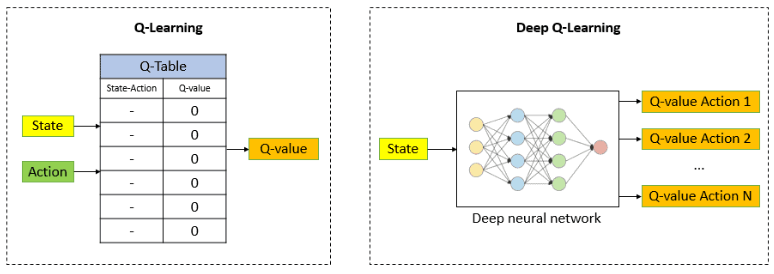
It is an extension of the basic Q-Learning algorithm which learns a table of Q-values for all the finite state-action pair combinations. DQN replaces the table of Q-values with a neural network which approximates the Q-values. This allows it to overcome the limitations of Q-Learning and makes it suitable for large and continuous state spaces (1). The input of the neural network is the state and the output is the Q-value for each possible action.
The following picture shows the difference between Q-Learning and DQN (2).
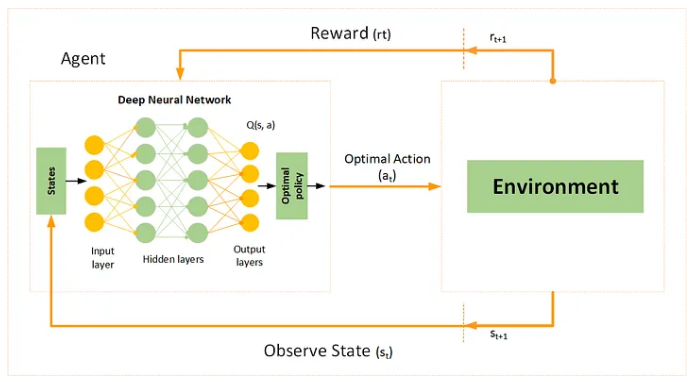
The structure of a DQN agent with the environment is as follows (1):
Deep Q-Learning Concepts
Q-Function Neural Network
DQN uses a neural network with parameters to approximate the Q-values . The input is the state and the outputs are the Q-values of all the actions. Then, the policy consists of selecting the action having the highest Q-value:
Replay Buffer
Since DQN is an off-policy method, it uses a replay buffer to store training samples . During training, mini-batches of experiences are randomly sampled from the buffer to update the parameters of the network. This approach breaks the correlation between consecutive experiences, improves generalization (3) and sample efficiency (1).
Target Network
DQN uses a separate network with parameters when calculating the targets to update the neural network weights. This stabilizes the training and eliminates the idea of a moving target. Without it, the parameters that we are training move the target as we train.
The loss function for training the Q-values neural network is (3):
The parameters of the target network get copied over from the main network periodically every some-fixed-number of steps.
Epsilon-Greedy Exploration
To balance exploration and exploitation during training, DQN uses an epsilon-greedy strategy. The agent selects a random action with probability (exploration), and selects the action that has the highest Q-value with a probability (exploitation) (2).
Pseudocode
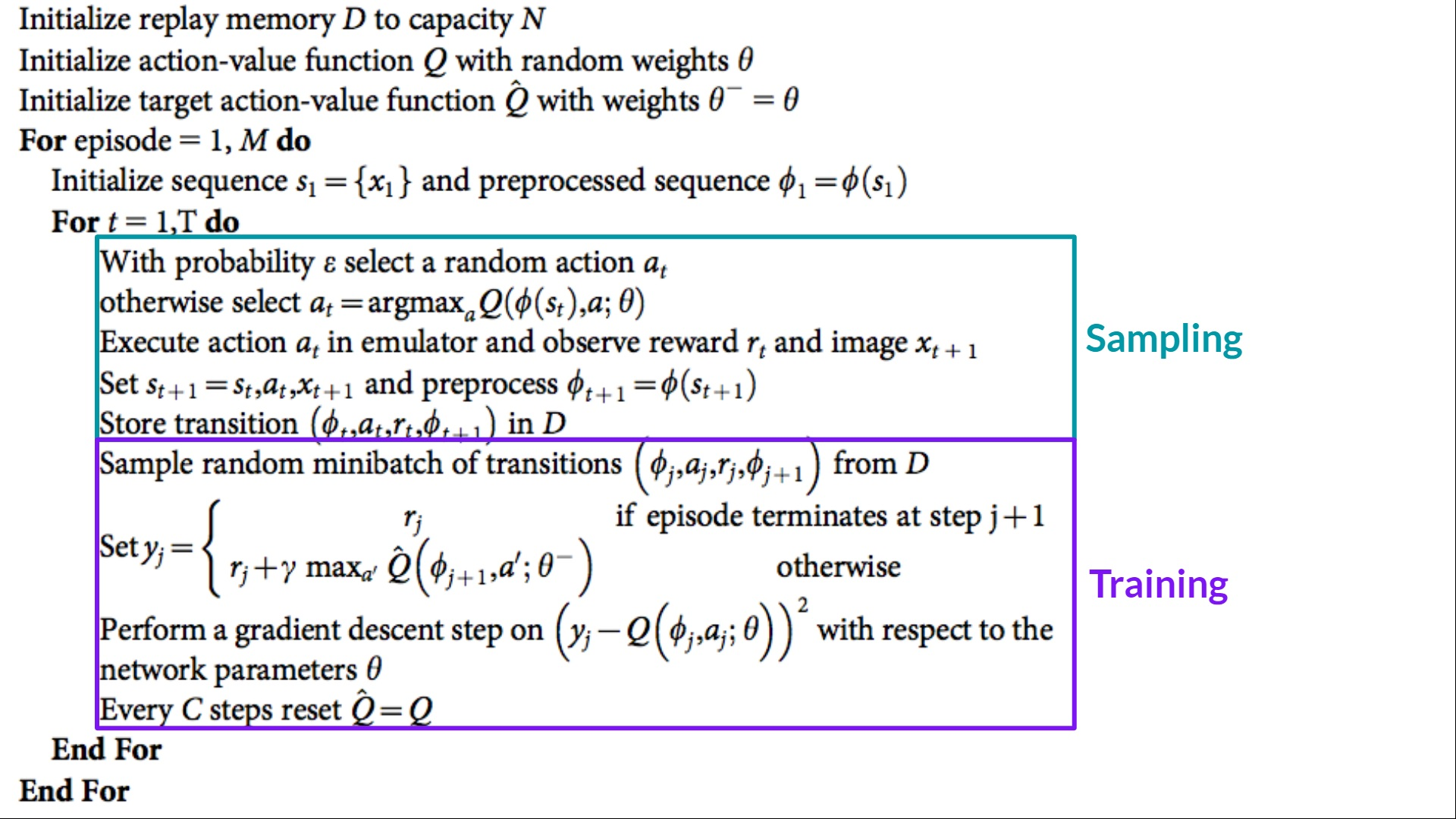
The following is the pseudocode for DQN with replay buffer, target network and epsilon-greedy exploration (4).
Drawbacks
The main drawback of DQN is the problem of Q-value overestimation. Double Deep Q-Learning was introduced to address this issue.
References
Backlinks
Notes that reference this page.
Connections
Direct relationships to this note.