Long N-step Surrogate Stage Reward (LNSS)
Topics: Reinforcement Learning
Introduction
Long N-step Surrogate Stage (LNSS) reward is a suggested stage reward formulation aimed at reducing the variance of Q value in deep reinforcement training. It is a combination of single-step and n-step methods, in the sense that it uses a weighted average of the rewards of the next N steps in order to perform single-step bootstrapping. Because of that, it can be easily piggybacked on state-of-the-art algorithms like DDPG, TD3 and D4PG.
The limitations that LNSS addresses are:
- the high variance problem in training, which impedes successful training and reduces performance
- n-step methods with large result in a large reward scale with hinders training
- the performance of single-step and n-step methods degrades in environments with noisy reward signals or corrupted sparse rewards.
Mathematical Details
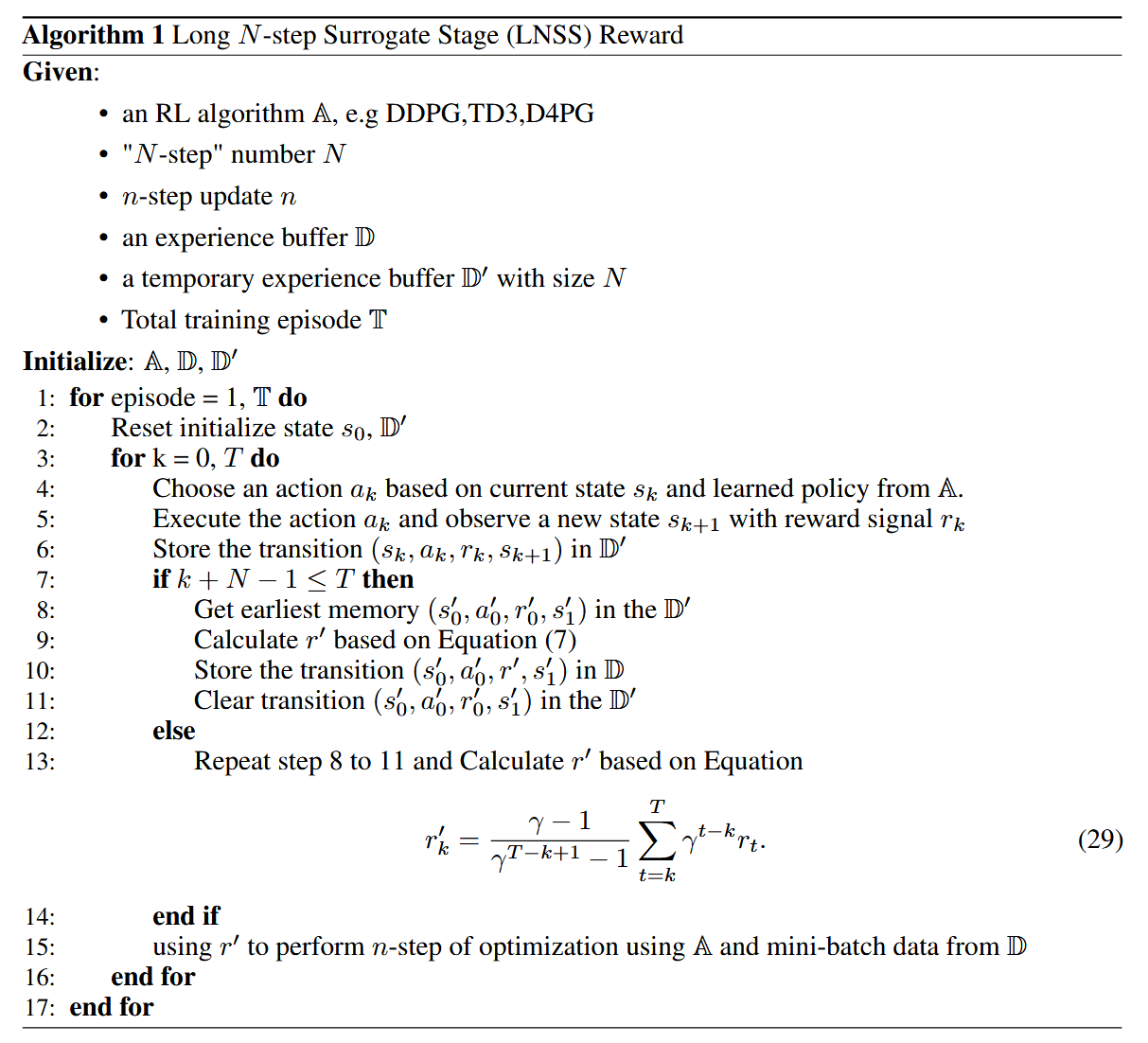
The concept of LNSS is to replace the single-step stage reward with a weighted average of the rewards of N steps. This way, the single-step bootstrapping method of DDPG and TD3 can be applied, but with a substitute stage reward computed from N steps.
Consider the N-step infinite horizon discounted return:
Then, the LNSS substitute stage reward is as follows (1):
Which is the weighted average of the rewards obtained over steps.
The equation can be further simplified by using the closed form of the geometric sum in the denominator:
The LNSS stage reward for step can only be calculated at step . Once is obtained, the training tuple is added to the replay buffer . Training then proceeds as normal for the algorithms, for example by sampling a learning batch from the replay buffer and updating the neural network weights.
Because LNSS uses a weighted average and is used in single-step bootstrapping, can be increased to high values like or without affecting the reward scale. Also, in sparse environments, LNSS continuously and progressively provides a reward starting from N steps backward from the time of achieving the desired state. This reduces the sparsity of the environment and turns the sparse reward into a dense reward.
Pseudocode
References
- Zhong, Junmin, Ruofan Wu, and Jennie Si. "A Long N-step Surrogate Stage Reward for Deep Reinforcement Learning." Advances in Neural Information Processing Systems 36 (2023): 12733-12745.
Backlinks
Notes that reference this page.
Connections
Direct relationships to this note.