Model Predictive Path Integral
Topics: Model Predictive Control
Introduction
Model Predictive Path Integral (MPPI) is a sampling-based model predictive control algorithm. It is, in a sense, a Monte Carlo MPC, where control inputs are sampled from predefined distributions and are propagated through the dynamics model to generate a large set of candidate trajectories. The algorithm scores the candidate trajectories, ranks them, and updates the distribution of actions by weighting the best trajectories.
MPPI is particularly effective for:
- Nonlinear dynamics, where motion isn’t simple or linear.
- Non-convex objectives, multiple possible paths or goals.
- Real-time decision-making in dynamic environments
Algorithm Structure
The MPPI algorithm starts with a vector/matrix of "nominal" control inputs and disturbance distribution (usually Gaussian) for every step in the finite control horizon. For example, if and , then there are control inputs and disturbance distributions.
The algorithm follows the below structured steps:
-
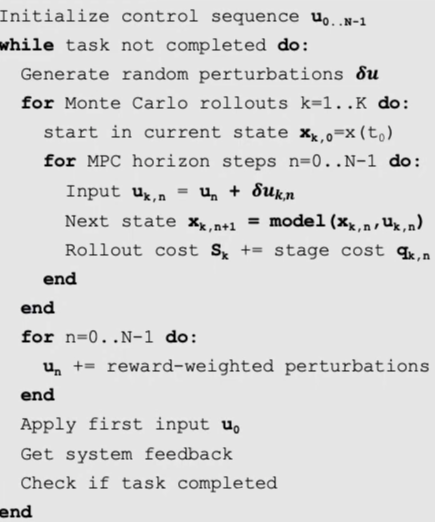
Trajectory generation: sample control inputs from the distributions () and propagate them through the system dynamics to obtain a large set of trajectories. The number of trajectories depends on the computation capabilities, but is usually in the hundreds or thousands. This enables the exploration of several candidate trajectories through stochastic sampling.
-
Cost Computation: evaluate each trajectory based on a predefined cost function
-
Control Update: First, assign a higher weight to the trajectories with lower cost using a softmax function:
where and are the weight and cost of trajectory respectively, and is a parameter that affects the degree of weighting.Then, update the nominal control sequence by computing a weighted average of the sampled control inputs:
The algorithm then employs a receding horizon strategy, meaning that only the first control input of the nominal trajectory is applied to the system, and the whole process repeats for the next timestep.

Pseudocode
References
Backlinks
Notes that reference this page.
Connections
Direct relationships to this note.