Note
UART
Topics: Embedded Systems
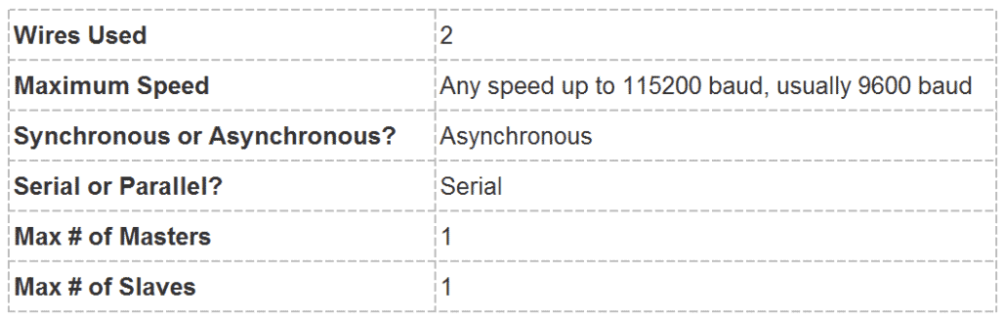
Universal Asynchronous Receiver-Transmitter (UART) is an asynchronous, serial, hardware communication protocol that uses two wires to send data between devices without a clock. Unlike SPI or I2C, it is a physical circuit in a microcontroller or a stand-alone IC. Since there is no clock signal, both UART devices must agree on a preset speed called baud rate, most commonly bits per seconds, or .
Here is a summary of the characteristics of UART:
Interface
Each UART device has 2 pins:
- Transmitter Tx
- Receiver Rx
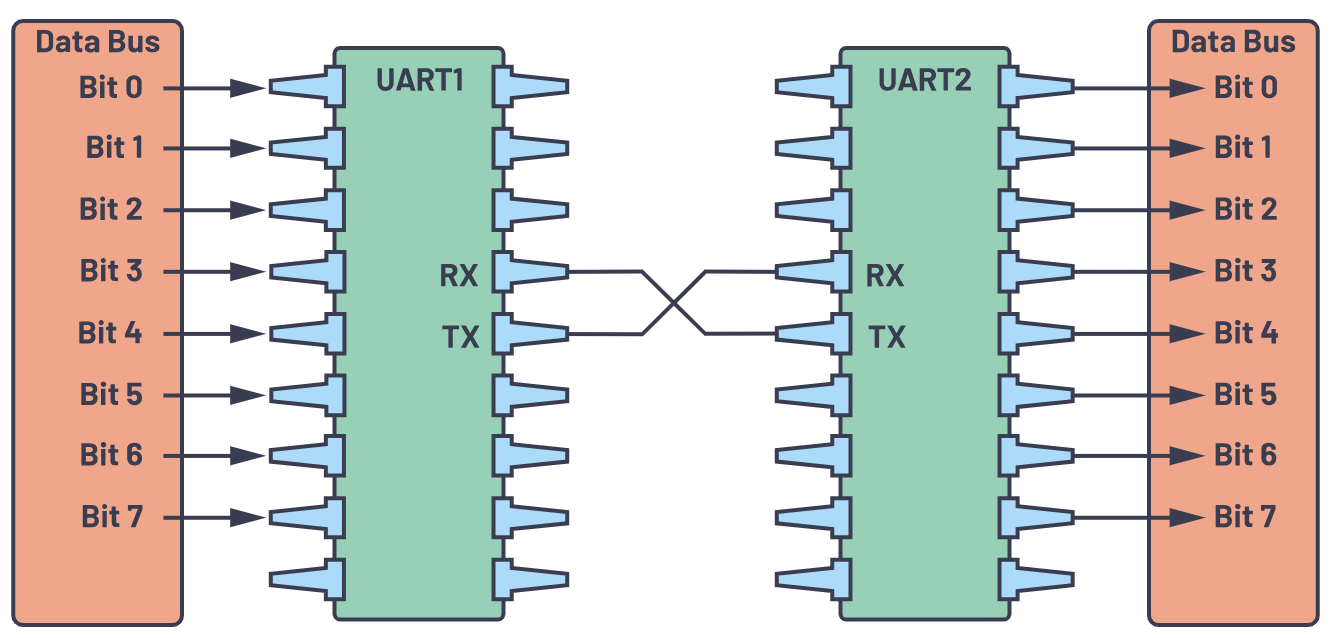
The data is transmitted serially on the wires, i.e. bit by bit.
Data Transmission
UART uses data packets of the following form for transmission:
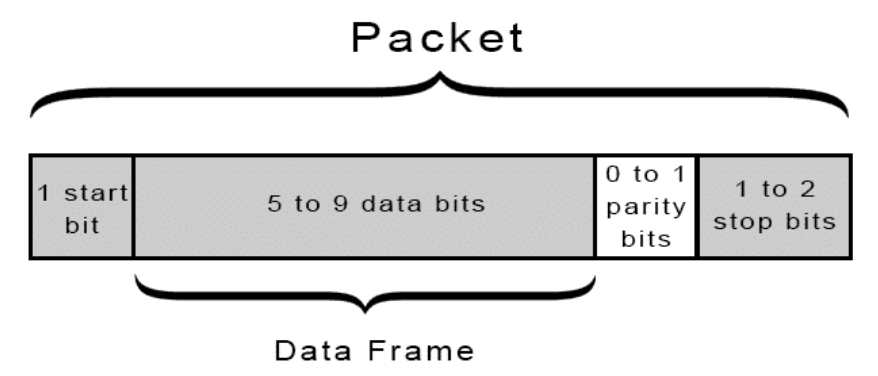
- start bit: the data line is normally held high; so to start data transfer, the UART devices pulls the line low for the duration of 1 bit
- data frame: the actual data being transferred. It is to bits if a parity bit is used, or to bits if it's not.
- parity bit: bit that denotes the evenness of the packet, used for error detection
- stop bits: drive the line high for to bit durations to signal the end of the packet
Advantages
- simplicity; if the application does not need a more sophisticated topology
- low wire count
- error checking with parity bit
Disadvantages
- limited to point-to-point communication between 2 devices
- no clock synchronization, which could lead to data corruption if the baud rates of the devices drift
- slower speeds than synchronous protocols like SPI
- Limited data frame
References
Backlinks
Notes that reference this page.
Connections
Direct relationships to this note.