Note
SARSA
Topics: Reinforcement Learning
Algorithm Overview
SARSA is a tabular, on-policy reinforcement learning algorithm that learns a discrete policy. It is targeted at environments with discrete state and discrete action spaces.
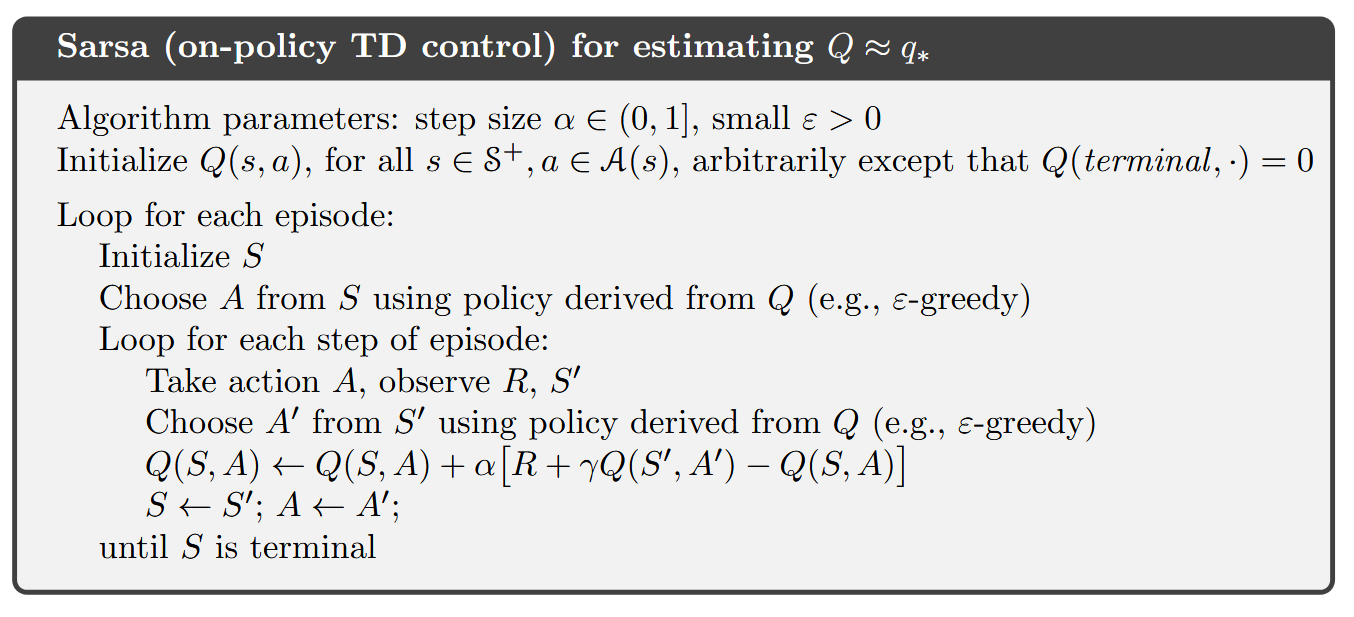
SARSA is based on the single-step temporal difference method. Its goal is to learn a table of Q-values. Therefore, it deals with transitions from state-action pair to state-action pair. After convergence, the optimal policy would be to select the action with the highest Q-value.
The update equation for SARA is (1):
where:
- is the learning rate
- is the target
This update is done after every transition from a non-terminal state.
Pseudocode
References
- R. S. Sutton and A. G. Barto, Reinforcement learning: an introduction. in Adaptive computation and machine learning. Cambridge, Mass: MIT Press, 2018.
Backlinks
Notes that reference this page.
Connections
Direct relationships to this note.