Categorical Policy
Topics: Reinforcement Learning
Definition
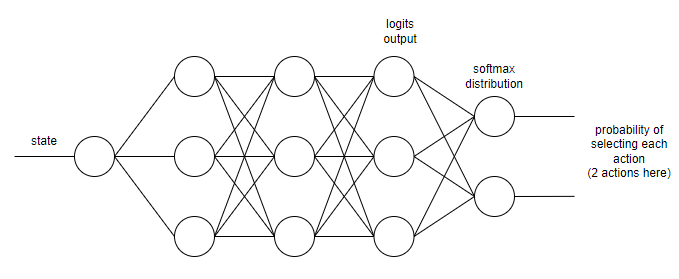
A Categorical Policy is a type of Stochastic Policies that is used for discrete action spaces. It is like a classifier over discrete actions. Given the state as input, the neural network outputs the probability of selecting each action.
The neural network structure is as follows: the input is the state (or observation), followed by some convolutional or densely-connected layers, followed by a final layer that gives the logits for each action, and finally a softmax distribution to convert logits into probabilities.
Sampling
Given the probabilities for each action, sampling is nothing more than using a categorical distribution/multinomial distribution probability mass function.
This can be done with PyTorch or TensorFlow.
Log-Likelihood
The last layer which contains the probabilities for the actions can be thought of as a vector .
The log-likelihood for an action can be obtained by indexing the vector:
References
Backlinks
Notes that reference this page.
Connections
Direct relationships to this note.