Underdamped System
Topics: Feedback Control Systems
An undamped system corresponds to in the standard form. The special case of is also called undamped system. The response of an undamped system has oscillations that decay exponentially and eventually settle.
Step Response
Intuition
As the damping increases from the undamped case:
- the frequency of the oscillations decrease by a multiplier related to the damping factor
- the response gets bounded by a decreasing exponential envelop
Poles
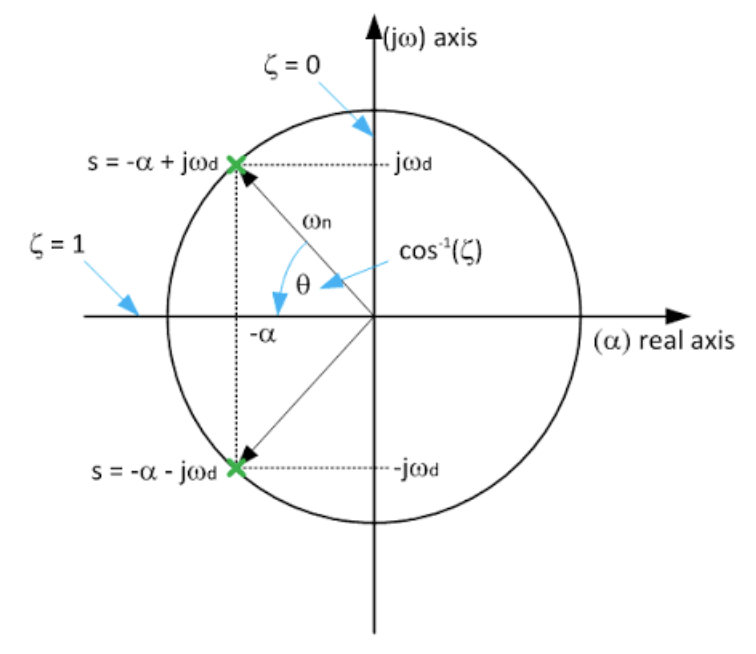
In the undamped case, the poles are on the imaginary axis at . As the damping factor increases, the poles start rotating away from the imaginary axis, with the origin as the center of rotation. In other words, the distance from the poles to the origin remains , but the angle between the imaginary axis and the pole-origin segment is related to the damping factor . Equivalently, the angle between the real axis and the pole-origin segment is related to the damping factor by . In short, the poles move along a circle of radius .
Backlinks
Notes that reference this page.
Connections
Direct relationships to this note.