PPO
Topics: Reinforcement Learning
Introduction
Proximal Policy Optimization (PPO) builds upon the same idea as TRPO: how can we take the biggest possible step in the policy while satisfying a divergence constraint so that the performance does not accidentally collapse?
Similarly to TRPO, it is an on-policy RL algorithm that can be used to train a stochastic policy with either discrete or continuous action spaces.
While TRPO solves the optimization problem with a complex second-order method, PPO is a first-order method that uses a few tricks, which makes it significantly simpler to implement.
There are 2 main variants of PPO: PPO-Penalty and PPO-Clip, which are discussed below.
Optimization Problem
Here is a reminder of the TRPO optimization problem:
PPO-Penalty
PPO-Penalty adds a penalty in the reward term instead of the constraint, turning the problem into an unconstrained optimization (2):
The first term of the optimization is the same surrogate objective from the TRPO problem. The second term aims to minimize the KL divergence.
The hyperparameter controls the weight of KL vs. objective and needs to be tuned. However, it is difficult to choose a single value of that performs well across different problems or even within the same problem across different stages.
Therefore, the can be adapted to achieve some target value of KL divergence each policy update:
- if then
- if then
The updated value is used for the next policy update.
PPO-Clip
L^{CPI}(\theta)=\hat{E}_t\Bigg[ \frac{\pi_{\theta}(a_t \vert s_t)}{\pi_{\theta_{old}}(a_t\vert s_t)} \; \hat{A}_t \Bigg] $$Without a constraint, maximizing $L^{CPI}(\theta)$ would lead to excessively large policy updates. So, the clipped objective is proposed as follows:L^{CLIP}(\theta)=\hat{E}t\Bigg[ \text{min} \bigg( \frac{\pi{\theta}(a_t \vert s_t)}{\pi_{\theta_{old}}(a_t\vert s_t)} ; \hat{A}t, ; \text{clip} \Big( \frac{\pi{\theta}(a_t \vert s_t)}{\pi_{\theta_{old}}(a_t\vert s_t)}, , 1-\epsilon, , 1+\epsilon \Big) \hat{A}_t \bigg) \Bigg]
where $\epsilon$ is a hyperparameter. The clipping removes the possibility for moving $\frac{\pi_{\theta}(a_t \vert s_t)}{\pi_{\theta_{old}}(a_t\vert s_t)}$ outside of the interval $[1-\epsilon, \, 1+\epsilon]$. This puts a limit on how much $\pi_{\theta}(a_t \vert s_t)$ can change with respect to $\pi_{\theta_{old}}(a_t\vert s_t)$. ## Pseudocode 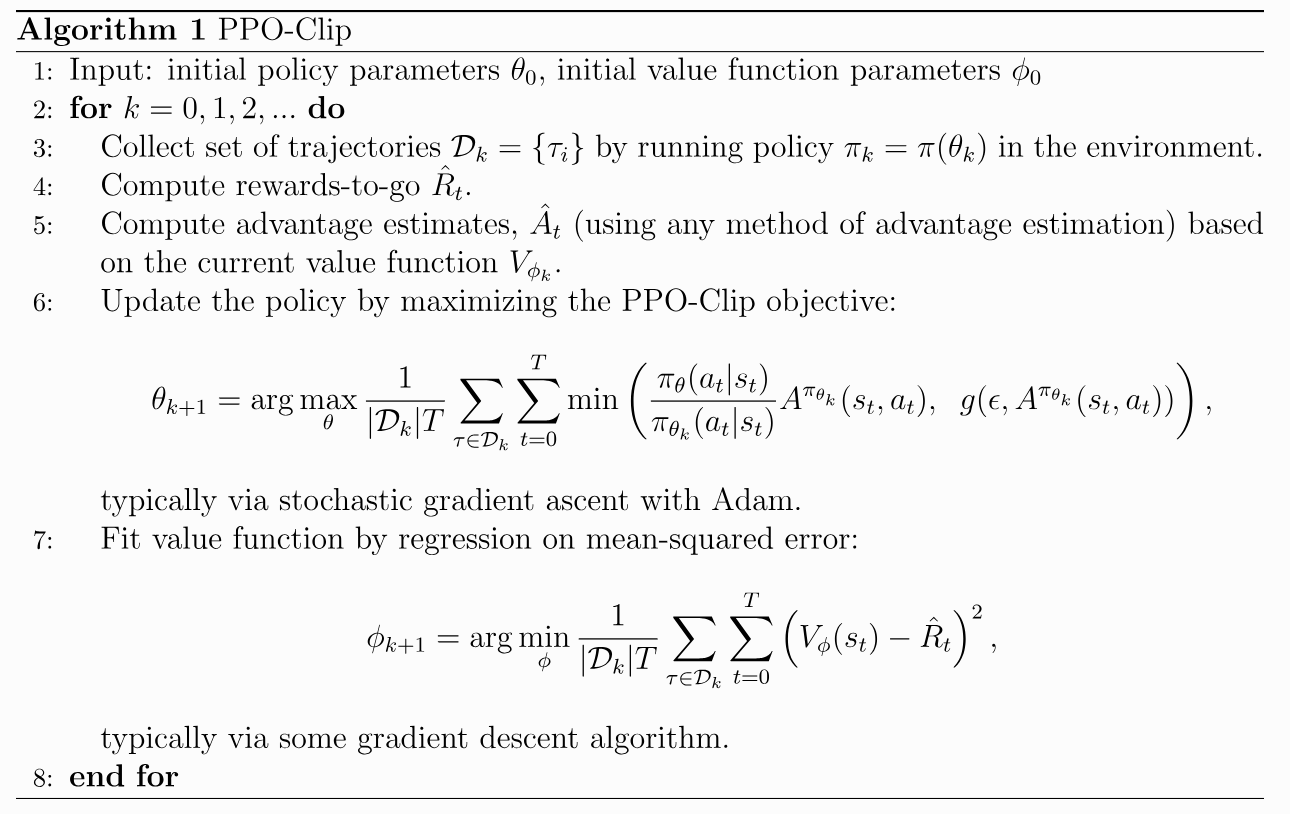 ## References 1. https://spinningup.openai.com/en/latest/algorithms/ppo.html 2. J. Schulman, F. Wolski, P. Dhariwal, A. Radford, and O. Klimov, “Proximal Policy Optimization Algorithms,” Aug. 28, 2017, _arXiv_: arXiv:1707.06347. doi: [10.48550/arXiv.1707.06347](https://doi.org/10.48550/arXiv.1707.06347).Backlinks
Notes that reference this page.
Connections
Direct relationships to this note.